

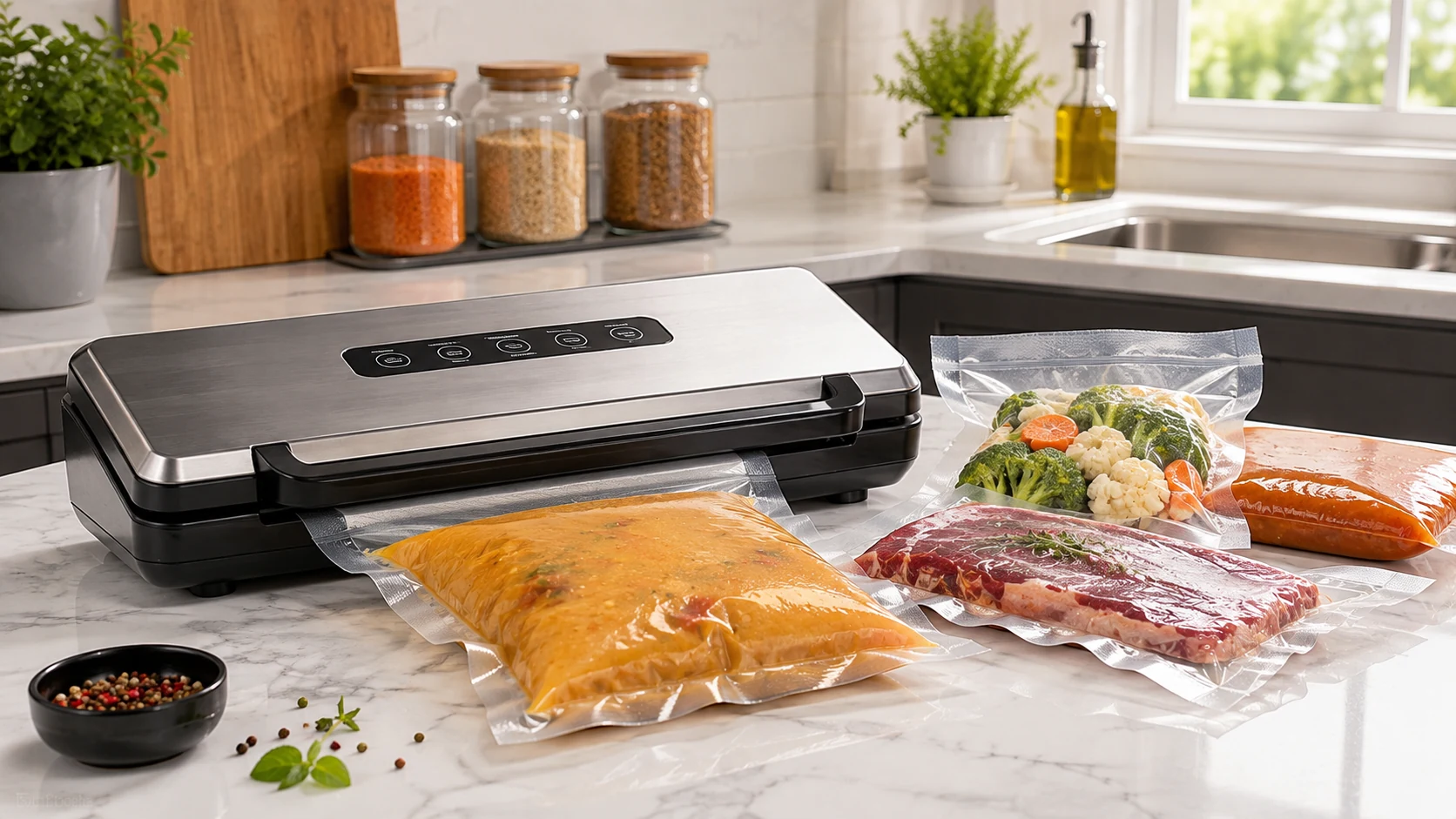
Keeping food fresh for longer can be easier when you have the right storage method. A Liquid Food Vacuum Sealer Machine is designed to remove air from specially designed vacuum bags and create a sealed package that can help with food storage, meal preparation, and organization.
Unlike basic vacuum sealers that are mainly intended for dry foods, some liquid-capable models are designed with dedicated settings for moist or liquid-rich foods such as soups, sauces, marinades, and stews. However, the exact capabilities can vary significantly between models, so checking the specific product listing before buying is important.
Some liquid-capable vacuum sealers also include features such as multiple sealing modes, an easy-lock handle, a built-in cutter, bag storage, a removable drip tray, and accessories for different types of food. These features can make the machine more convenient for regular kitchen use.
In this guide, we’ll look at what a liquid food vacuum sealer does, its key features, advantages and disadvantages, who should consider buying one, and what to check before making a purchase.
Disclosure: As an Amazon Associate, we may earn from qualifying purchases made through links on this page. This does not affect the price you pay.
Quick Overview
A Liquid Food Vacuum Sealer Machine is a kitchen appliance designed to vacuum-seal and preserve different types of food.
Traditional vacuum sealers can work very well with dry foods, but liquids can be more difficult because liquid may be pulled toward the vacuum pump during the air-removal process.
Liquid-capable models address this problem by offering dedicated liquid or moist-food settings. Some models available today specifically advertise modes for dry, moist, and liquid foods.
These machines can be useful for:
- Soups
- Stews
- Sauces
- Marinades
- Meat
- Vegetables
- Leftovers
- Meal-prep foods
- Dry and moist ingredients
The exact foods and operating methods supported depend on the model.
Liquid Food Vacuum Sealer Machine Review
The biggest reason to consider a liquid food vacuum sealer is its versatility.
A standard vacuum sealer is often most convenient for solid or relatively dry foods. When liquids are involved, the vacuum process can become more challenging because the liquid can move through the bag toward the suction area.
A machine specifically designed for liquid or moist foods can make this type of food preservation more practical.
Some current liquid-capable models provide separate dry, moist, and liquid modes. For example, Vakumar’s liquid vacuum sealer documentation describes dedicated settings for different food types, while other models such as SEATAO advertise separate liquid sealing capabilities.
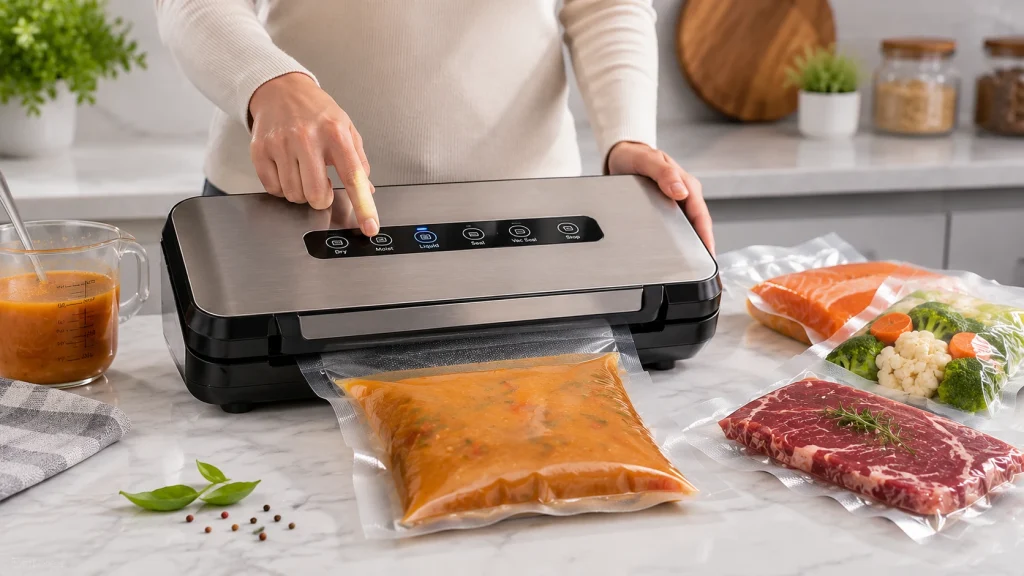
Another useful feature found on some models is an easy-lock handle. Instead of manually holding the lid down throughout the process, the handle helps secure the sealing chamber while the machine operates.
For people who regularly prepare meals in advance, this can be useful. Vacuum-sealed food can take up less space than some traditional storage methods, and sealed bags can be convenient for organizing food in a refrigerator or freezer.
A built-in cutter is another practical feature. Rather than keeping a separate pair of scissors nearby, some machines allow you to cut vacuum-sealing rolls to the size you need.
Some models also include integrated bag storage, making the entire sealing process more convenient.
However, it is important not to assume that every machine marketed as a “liquid vacuum sealer” can safely vacuum every type of liquid. Always follow the manufacturer’s instructions for the particular model you purchase.
Key Features of a Liquid Food Vacuum Sealer Machine
Liquid and Moist Food Modes
The most important feature to look for is a mode specifically designed for moist or liquid foods.
Some models provide separate settings for dry, moist, and liquid foods, allowing the machine to adjust the sealing process depending on the type of food being packaged.
This can be particularly useful when sealing soups, sauces, marinades, and other foods with significant moisture.
Multiple Operating Modes
Some liquid-capable vacuum sealers offer several operating modes.
Depending on the model, these may include vacuum-and-seal, seal-only, pulse, container, marinade, dry, moist, or liquid modes.
Having multiple modes can make the machine more versatile, although you should choose a model based on the features you actually need rather than simply selecting the one with the largest number of buttons.
Strong Vacuum Performance
Vacuum strength is an important consideration because the machine needs to remove air from the bag before sealing it.
Some liquid-focused models advertise high vacuum pressure, including models rated around 90 kPa. However, vacuum ratings can differ between manufacturers and shouldn’t be the only factor used to judge a machine.
Easy-Lock Handle
An easy-lock handle can make operation more convenient.
Some models use a locking mechanism that secures the lid before the vacuum and sealing cycle begins. This can be useful if you regularly seal multiple bags during meal preparation.
Built-In Cutter
A built-in cutter can be helpful when using vacuum-sealing rolls.
You can cut a bag to the approximate size needed instead of relying on pre-cut bags. This can also reduce unnecessary packaging waste when you’re sealing foods of different sizes.
Bag Storage
Some vacuum sealers include storage space for sealing rolls.
This keeps the roll close to the machine and can make the kitchen counter more organized.
Removable Drip Tray
A removable drip tray can be particularly useful when working with moist or liquid foods.
If some liquid escapes during the sealing process, a removable tray can make cleanup easier. Some current liquid vacuum sealers specifically include this feature.
LED Display or Indicators
Some modern models include an LED display or indicator lights to show the selected mode and progress of the sealing process.
This can make operation easier, especially when the machine offers several different functions.
Pros and Cons
Pros
- Designed to handle different types of food
- Some models offer dedicated liquid and moist-food modes
- Useful for meal preparation and food storage
- Can help organize food in the refrigerator or freezer
- Built-in cutters are convenient when using sealing rolls
- Some models include bag storage
- Easy-lock handles can simplify operation
- Multiple modes can provide greater flexibility
- Useful for soups, sauces, marinades, and other suitable foods
- Can also be used for many dry foods
Cons
- Features vary significantly between models
- Liquid sealing requires following the manufacturer’s instructions carefully
- Not every vacuum sealer is suitable for liquids
- Requires compatible vacuum-sealing bags or rolls
- Bags and rolls are an ongoing consumable cost
- Some machines can take up noticeable countertop space
- More advanced models can have controls that take time to learn
Who Should Buy a Liquid Food Vacuum Sealer Machine?
A liquid food vacuum sealer can be particularly useful for people who regularly prepare meals in advance.
If you make soups, sauces, marinades, stews, or other moist foods in larger quantities, having a machine designed for liquid or moist food can make portioning and storage more convenient.
It’s also useful for people who buy food in bulk. Meat, vegetables, and other suitable foods can be portioned into individual packages before being stored.
Home cooks may also appreciate the ability to prepare food ahead of time.
For example, you can portion ingredients for future meals and seal them individually, making it easier to organize your refrigerator or freezer.
A vacuum sealer can also be useful for reducing the amount of air inside food-storage bags, which can help with organization and may reduce exposure to air compared with ordinary storage bags.
Who Should Not Buy a Liquid Food Vacuum Sealer Machine?
A liquid vacuum sealer may not be necessary if you rarely store food for extended periods or usually prepare small portions that are eaten immediately.
It may also be unnecessary if you only need a basic sealing machine for occasional dry foods.
If you’re primarily interested in sealing liquids, make sure the specific model you’re considering actually supports liquid vacuum sealing. Some conventional vacuum sealers explicitly state that they are not suitable for vacuuming liquid foods, so the wording on the product listing and manual matters.
You should also avoid choosing a machine simply because it advertises a high vacuum-pressure number. Ease of use, liquid handling, sealing quality, cleanup, and reliability are all important.
What to Consider Before Buying
Liquid Compatibility
This should be your first consideration.
Check whether the specific machine supports true liquid vacuum sealing or only moist foods.
There is an important difference between a “moist” setting and a dedicated liquid mode. Some machines are designed specifically for liquids, while others recommend alternative methods such as freezing liquid foods before vacuuming.
Sealing Quality
A strong, consistent seal is essential.
A vacuum is only useful if the bag remains properly sealed afterward.
Look for a machine that provides a reliable heat-sealing system and follow the manufacturer’s recommendations regarding bag placement.
Bag Compatibility
Check what type of bags or rolls the machine accepts.
Some models are designed to work with standard vacuum-sealer rolls, while others may have specific recommendations.
If you plan to use the machine regularly, also consider the ongoing cost and availability of compatible bags.
Drip Tray and Cleanup
Liquid foods can make cleanup more complicated than dry foods.
A removable drip tray can be useful because it allows you to clean the area more easily after sealing moist or liquid foods.
Cutter and Bag Storage
If you’re using vacuum rolls, a built-in cutter can save time.
Integrated storage can also make the machine more convenient because the roll can remain close to the sealer.
Controls
Look for controls that are easy to understand.
If you’re mainly sealing dry and moist foods, you may not need a machine with a large number of modes.
If you regularly work with different foods, however, additional modes may be useful.
Countertop Space
Vacuum sealers are generally smaller than many kitchen appliances, but they still require space for operation.
Check the machine’s dimensions before purchasing and make sure you have enough room to place bags correctly.
Ease of Cleaning
Cleaning is particularly important when working with liquid foods.
Look for features such as removable trays and accessible sealing areas that make it easier to wipe away food residue.
Liquid Food Vacuum Sealer Machine vs. Regular Vacuum Sealer
The biggest difference is the type of food the machine is designed to handle.
A basic vacuum sealer may be perfectly suitable for dry foods such as meat, nuts, vegetables, and other solid ingredients.
Liquid-capable machines are designed with additional functions intended to make moist or liquid foods easier to seal.
If you mostly seal dry foods, a standard machine may be enough.
If soups, sauces, marinades, or other liquid-rich foods are a regular part of your meal preparation, a liquid-capable machine can offer greater flexibility.
However, always check the specific manual because not every product marketed as a vacuum sealer has the same liquid-handling capabilities.
Liquid Food Vacuum Sealer Machine vs. Traditional Food Storage Bags
Traditional food-storage bags are inexpensive and convenient, but they generally leave more air around the food.
Vacuum sealing removes much of the air from the package before creating the seal.
This can make vacuum bags useful for organized freezer storage and meal preparation.
The trade-off is that you need a vacuum sealer and compatible bags or rolls.
For occasional food storage, ordinary containers or storage bags may be sufficient. For frequent meal preparation and bulk food storage, a vacuum sealer can be more practical.
How to Use a Liquid Food Vacuum Sealer Machine
Before using the machine, read the instructions for your specific model.
For dry or moist foods, place the food inside an appropriate vacuum-sealing bag while leaving enough space at the open end for sealing.
Position the open end of the bag correctly inside the sealing area.
Select the appropriate mode based on the food you’re packaging.
For liquid foods, follow the manufacturer’s specific liquid-sealing instructions. Some machines provide a dedicated liquid mode, while other models may recommend different techniques.
Start the vacuum and sealing cycle.
Once the process is complete, check the seal to make sure it is properly closed.
For liquids, take extra care when moving the sealed bag. A good seal should remain intact, but rough handling can damage the packaging.
If you’re preparing food for refrigerator or freezer storage, always follow appropriate food-safety and storage practices.
Frequently Asked Questions
Can a vacuum sealer seal liquid food?
Some vacuum sealers are specifically designed for liquid or liquid-rich foods, while others are not. Always check the manufacturer’s instructions because some standard vacuum sealers specifically warn against vacuuming liquids.
What liquids can be vacuum sealed?
Depending on the machine, suitable foods may include soups, sauces, marinades, stews, and other liquid-rich foods. The exact recommendations vary by model, so follow the instructions provided with your vacuum sealer.
Is a liquid vacuum sealer better than a regular vacuum sealer?
If you regularly seal liquids or moist foods, a machine with dedicated liquid-handling capabilities can be more useful. If you mainly seal dry foods, a simpler vacuum sealer may be sufficient.
Can you vacuum seal soup?
Some liquid-capable vacuum sealers are specifically designed for soups and similar foods. However, you should use the machine’s dedicated liquid mode if available and follow the manufacturer’s instructions carefully.
Can you vacuum seal marinades?
Some liquid-capable machines support marinades, and certain models specifically advertise marinade modes. Always check the instructions for the particular machine before using it with liquids.
Do vacuum-sealed bags keep food fresh longer?
Vacuum sealing removes much of the air from the bag and creates a sealed package, which can help with food storage. However, vacuum sealing does not replace proper refrigeration, freezing, food handling, or safe storage practices.
Is a liquid food vacuum sealer worth buying?
It can be worth considering if you regularly prepare meals, buy food in bulk, or store soups, sauces, marinades, meat, and other suitable foods. For someone who rarely vacuum seals food, a dedicated machine may provide less value.
Final Verdict
A Liquid Food Vacuum Sealer Machine can be a useful addition to a kitchen, especially for people who regularly prepare meals in advance or store moist and liquid-rich foods.
Its biggest advantage is versatility. A suitable liquid-capable model can handle more than ordinary dry-food vacuum sealing, with some machines offering dedicated liquid, moist, and dry modes. Features such as built-in cutters, bag storage, easy-lock handles, multiple operating modes, and removable drip trays can make regular use more convenient.
The most important thing is to choose the right model for your needs. Don’t assume that every vacuum sealer can safely vacuum liquids. Always check the product specifications and manufacturer’s manual before using a machine with soups, sauces, or other liquid foods.
If you frequently meal-prep, buy food in bulk, or want a more organized way to store suitable foods, a liquid food vacuum sealer can be a practical kitchen appliance to consider.